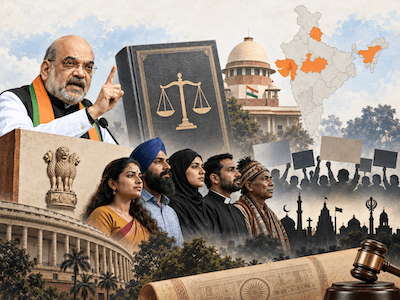
Union Home Minister Amit Shah said on Sunday (September 13) that the Uniform Civil Code (UCC) will be implemented in all 21 states where the National Democratic Alliance (NDA) was in power before the 2029 Lok Sabha elections. “Some states have introduced UCC. It is our resolve to enforce UCC in all 21 BJP-led NDA-ruled states before 2029 Lok Sabha polls,” he said in Mumbai while speaking to reporters. Shah was addressing a press conference over Sewa Sankalp Abhiyan, a month-long mass outreach campaign starting from September 17, which is the birthday of Prime Minister Narendra Modi. Listing his government’s major reforms, he said, “Our government abolished triple talaq, which gave equal rights to Muslim women. We scrapped Article 370 without shedding a drop of blood and firing a bullet.”
The UCC seeks to reform the personal laws on marriage, divorce, inheritance and succession etc. It has been an item on BJP’s agenda for a long time, and is one of the unfinished items among the party’s ideological objectives. The other objectives – abrogation of Article 370 that gave a special status to Jammu & Kashmir; and construction of a Ram temple in Ayodhya – are now achieved. After the Gujarat Assembly passed the UCC Bill in March 2026, Shah had said that having one law for every citizen had been a commitment of the party “since its inception”.
The promise to pass the UCC stems from Article 44 of the Constitution of India that says: “The State shall endeavour to secure for the citizens a uniform civil code throughout the territory of India.” This Article was adopted by the Constituent Assembly on November 23, 1948, after a spirited debate. The Constituent Assembly had no consensus on what a UCC would entail, which was among the reasons it was placed among the Directive Principles of State Policy, not the Fundamental Rights. Under Article 37, the Directive Principles are fundamental to governance but are not enforceable by any court.
The debate has continued since then. The debate around UCC has always been about what should be made uniform and how that uniformity should be reconciled with freedom of religion, customary practices and constitutional protections for tribal communities. The BJP kept the debate alive since its inception. It gained momentum after Uttarakhand, a BJP-ruled hill state, became the first Indian state to implement a UCC in January 2025, providing common rules on marriage, divorce, inheritance and succession, prohibiting polygamy and mandating marriage registration. One of the code’s most distinctive features is the regulation of live-in relationships: couples are required to register the relationship and its termination, while children born from such relationships are recognised as legitimate. Enactment of the UCC was one of the BJP’s key poll promises in the state during the 2022 Assembly elections. After returning to power, Chief Minister Pushkar Singh Dhami appointed a committee led by retired Supreme Court judge Justice Ranjana P Desai to make a draft code. The committee submitted the draft on February 2, 2024, and the Dhami government tabled the Uniform Civil Code (UCC) Bill in the state Assembly on February 6, 2024. The Assembly passed the bill the next day, that is on February 7, and the bill got the President’s assent in March the same year. Uniform Civil Code Act, 2024, became effective from January 2025. Three other BJP-ruled states Gujarat, Assam and Madhya Pradesh have also passed the UCC bills in March, May and July this year, respectively, and broadly follow the Uttarakhand model. A significant common feature of the codes in these four states is that Scheduled Tribes are excluded from these laws, with Uttarakhand also exempting certain communities protected by constitutional customary-law provisions. The four codes are therefore similar, but not identical and none is literally universal.
BJP and its allies in the NDA view the UCC as a progressive step toward achieving equality and eliminating discriminatory practices based on religion – Uttarakhand CM called it historic when the bill was passed in the state Assembly – but the opposition’s position has been this: the UCC infringes on the religious and cultural rights of minorities, particularly concerning marriage, inheritance, and personal laws. A UCC could homogenize diverse traditions and undermine social harmony, they state. The Muslims, particularly, are apprehensive about the impact of the UCC on their existing personal laws, calling UCC a “Hindu code”. The Congress has questioned whether the BJP’s UCC is genuinely a gender-equality reform or an attempt to alter the personal laws of minorities through a majoritarian framework. The party opposed the Gujarat Bill as “anti-Muslim”, while in Madhya Pradesh it criticised the legislation as an RSS agenda. Opposition parties in Assam also sought wider consultation and raised concerns over the tribal exemption and regulation of live-in relationships. Even BJP’s NDA allies such as the JD(U) have said they are not opposed to UCC but want it to emerge through consensus rather than being imposed. Nitish Kumar had told the Law Commission that a UCC should respect India’s “delicate balance” between different religious and ethnic groups. TDP has similarly called for discussion and consensus and, in 2024, said it would ensure that Muslim interests were protected.
Even the Law Commission has called it “neither necessary nor desirable”. The 21st Law Commission, in its 2018 Consultation Paper on Reform of Family Law, argued for reforming discriminatory provisions across personal laws while preserving India’s diversity. Its emphasis was on achieving “equality within communities” between men and women rather than “equality between” communities, and on making piecemeal changes rather than imposing absolute uniformity. It also flagged the constitutional protections enjoyed by tribal and North-eastern communities as a complication.
The 22nd Law Commission reopened the issue in 2023, seeking fresh views from the public and recognised religious organisations. It said more than three years had elapsed since the 2018 consultation and that developments, including court orders, warranted a fresh examination.
The UCC is rooted in the RSS thought – although the organisation’s approach has been more cautious on the manner and timing of implementation – and the Sangh’s preference was for BJP-ruled states to enact their own codes first, with the Centre potentially considering an overarching law later. But the BJP is preferring to go for a state-first strategy and may not go for a national code because a single national code would have to negotiate India’s enormous variation in personal laws and customary practices, particularly among tribal communities and in the Northeast. BJP leaders have insisted that UCC could not simply be “codified” like the criminal law because an Uttarakhand or Himachal tribal community had very different practices from one in Chhattisgarh or the Northeast.
Amit Shah’s statement in Mumbai keeps UCC politically alive while allowing the party to present it as a measure of equal rights and social reform.