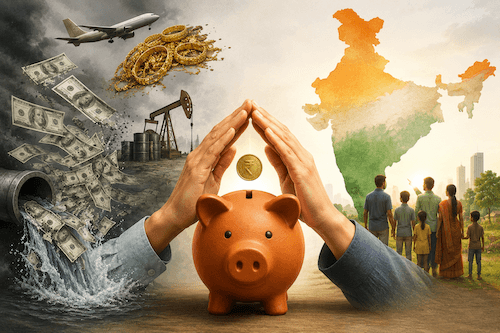
In a rare intersection of economics and everyday lifestyle, Prime Minister Narendra Modi has spent the past several years asking ordinary Indians to rethink how they spend, travel, and consume. His message, delivered from Mann Ki Baat radio broadcasts, public rallies, and national addresses, carries a simple but powerful economic argument: every rupee spent on a foreign holiday, every sovereign of imported gold, every litre of imported crude oil, quietly drains India’s foreign exchange reserves and collectively, those drains add up to hundreds of billions of dollars a year.
The appeal has grown louder in 2025 and 2026 as economic pressures mounted. Speaking in Hyderabad in May 2026, Modi urged citizens to skip non-essential overseas travel, including destination weddings abroad for at least a year. He linked the request directly to conserving foreign exchange, reducing fuel use, and cutting imports during a period of global instability. “Choose India first,” was the spirit of his message.
The Numbers Behind the Appeal
The economic context is hard to ignore. India’s foreign exchange reserves fell from approximately $728 billion in February 2026 to $691 billion by April, a drop that caught the attention of policymakers and economists alike. More structurally, India’s trade deficit tells a sobering story: in FY 2024–25, India imported goods and services worth $915 billion against exports of $821 billion, leaving a trade gap of over $94 billion.
Gold is one of the biggest culprits. India, the world’s second-largest gold consumer after China, saw its gold import bill nearly double in just two years, from roughly $35 billion in 2022–23 to nearly $72 billion in 2025–26, a jump of around 24% in a single year. Since India produces almost no gold domestically, every purchase drains dollar reserves.
Overseas travel is another major outflow. Under the Liberalised Remittance Scheme (LRS), which allows Indians to send money abroad, outward remittances stood at $29.56 billion in FY25. Of that, travel alone accounted for $16.96 billion, more than half. In the first eleven months of FY26, foreign travel had already consumed nearly $15 billion, or about 57% of all LRS outflows.
Study abroad adds a less-discussed but significant layer to this outflow, one that directly affects students and their families. According to NITI Aayog, Indian students’ overseas tuition fees and living expenses now amount to approximately ₹6.3 trillion, roughly 2% of India’s GDP, making education one of the largest contributors to the LRS outflow over the past decade.
While these numbers show some natural correction, the structural reality remains: for every one foreign student coming into India for higher education, 28 Indian students go overseas, a ratio that heavily favours outbound spending. Many families are now exploring alternatives, Europe’s affordable public universities, hybrid online–offline programmes, and India’s own growing roster of world-ranked institutions, as both practical necessity and quiet patriotism.
Meanwhile, India imports roughly 89% of its crude oil needs. When global oil prices spike, as they did during the West Asia conflict, the dollar outflow rises sharply, widening both the trade deficit and current account deficit, the latter standing at $13.2 billion or 1.3% of GDP in the December quarter of 2025.
What Modi Has Been Asking For
PM Modi’s appeals, spread across multiple platforms over several years, cover a wide range of consumption choices:
- Avoid unnecessary foreign travel, particularly luxury vacations and destination weddings abroad
- Choose domestic tourism to keep spending within India and support local livelihoods
- Postpone non-essential gold purchases for at least a year to ease pressure on reserves
- Save fuel and reduce dependence on petroleum products by using public transport, carpooling, and metro rail
- Work from home wherever possible, and hold virtual meetings instead of travel-intensive office visits
- Switch to electric vehicles (EVs) to cut petrol and diesel consumption
- Shift to online education where feasible, reducing the need for physical commuting and fuel use
- Buy ‘Made in India’ products across electronics, toys, textiles, defence equipment, and daily goods
- Reduce dependence on chemical fertilisers and import-heavy agricultural inputs
These appeals sit within a larger policy framework. Since 2014, the government has promoted Make in India, and since 2020, the broader vision of Atmanirbhar Bharat (Self-Reliant India) has encouraged domestic production in sectors from defence to electronics to food processing. The Vocal for Local slogan, popularised during the COVID-19 pandemic, further urged citizens to consciously prefer Indian goods and services.
How People and Leaders Are Responding
The appeal has found genuine resonance in parts of Indian society. Many middle-class families, particularly those conscious of their national identity, report choosing Rajasthan, Kerala, or Himachal Pradesh over Bali or Dubai for their holidays. Social media influencers promoting domestic travel and ‘Desi brands’ have seen growing audiences. Some state governments and tourism boards have launched campaigns to attract urban Indians to lesser-known domestic destinations.
Businesses in sectors like handloom textiles, traditional handicrafts, and organic food have reported increased interest. Young entrepreneurs in tier-2 cities are launching Made-in-India brands in cosmetics, stationery, and electronics accessories, citing both patriotism and the practical opportunity created by growing domestic demand.
What Economists Say
The economic logic behind reducing import dependence is sound, say most analysts but experts urge caution against oversimplification.
“Reducing non-essential imports like luxury foreign travel and speculative gold buying does ease current account pressure,” notes the broad consensus among mainstream economists. “But structural dependence on crude oil, semiconductors, and industrial inputs cannot be solved by consumer behaviour alone, it requires massive investment in domestic manufacturing capacity.”
Some economists, notably former Chief Economic Adviser Arvind Subramanian and others, have warned that an import-substitution-heavy strategy risks reverting to the inward-looking economic model India abandoned in 1991. They argue that sustainable growth requires integration with global supply chains, not retreat from them.
Challenges Ahead
The path to meaningful import reduction is neither simple nor swift. Key challenges include:
Quality and competitiveness: Domestic manufacturers in several sectors still lag behind global peers in design, innovation, and after-sales service — areas where consumer preference is hard to shift by appeal alone.
Price parity: Indian-made goods are often costlier than their imported equivalents, particularly in electronics and textiles, where global supply chains drive down prices.
Consumer habit: Decades of globalisation have shaped consumer preferences. Changing them requires time, trust, and consistently improving product quality.
Structural dependencies: India’s import bill is dominated by crude oil, which cannot be reduced quickly without a massive transition to renewable energy, a process underway but far from complete.
A Long Game, Worth Playing
PM Modi’s repeated appeals to reduce India’s foreign exchange outflow are rooted in genuine economic concern. The numbers, a $94 billion trade deficit, $72 billion in gold imports, nearly $17 billion in outbound travel spending annually, and ₹6.3 trillion in student education expenditure overseas, make the case clearly. When a country spends significantly more foreign currency than it earns, the rupee weakens, inflation rises, and economic vulnerability grows.
But critics are right to demand consistency from leaders and from policy. Economic self-reliance is not built in a speech or a slogan; it is built through sustained investment, quality improvement, competitive pricing, and trust. India’s long-term economic strength depends less on whether citizens skip one foreign holiday, and more on whether the country can build the manufacturing depth, energy independence, and export competitiveness to reduce structural import dependence over the next decade.
In that larger effort, every conscious choice to buy local, travel within India, and invest in homegrown innovation does matter as one small thread in a much larger economic fabric that India is still weaving.


