—Ritesh Sharma,
Law Consultant & Social Entrepreneur
Every generation inherits a political symbol. This one chose the cockroach.
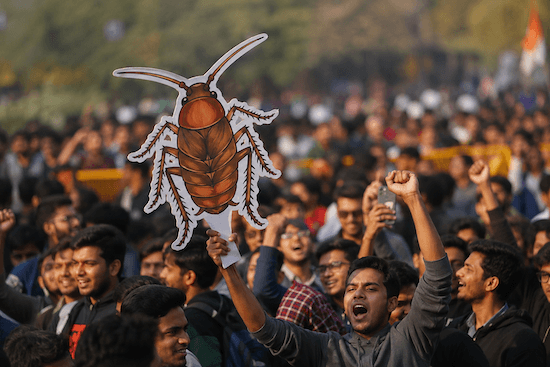
No strategist designed it; no party commissioned it. Yet, the cockroach has become one of the most unlikely political symbols of contemporary India. The Cockroach Janta Party (CJP) was not founded upon grand revolutionary ideals or calculated election tactics. It was founded upon rage.
When remarks made during a Supreme Court hearing were widely perceived as equating unemployed youth with “cockroaches” and “parasites,” social media responded with outrage. The Chief Justice clarified that his comments were made in reference to individuals who hold fraudulent degrees and not about unemployed, however, the damage was already done. The public chose to embrace the insult, giving rise to an unexpected political movement.
The Anatomy of Frustration
The cockroach was never the problem. It became an emblem for a generation that has believed itself to be ignored after years of schooling and numerous competitive examinations and then years of waiting for jobs that never materialised. When combined with the government delays in filling positions, leaks of competitive examination papers, coupled with ever rising cost of living, the remarks created a face of frustration that had already existed.
A disturbing trend has taken hold in public discourse. Time and again citizens, especially the youth, have been described through various labels instead of recognising the vulnerabilities and aspirations that define their lives. Anti-national, urban Naxals, toolkits, andolanjeevi, lazy, freebie seekers, and a host of others labels that attempt to describe citizens especially youth as those that simply do not wish to work. Each label has originated in distinctly different political contexts, yet unfortunately, they all stem from the same trend, oversimplifying and overlooking the complex social issues.
Language is never casual for lawyers. In courtrooms, it is known that language creates perception. The Constitution upholds the dignity of all individuals. When people in high positions in government- judges, ministers, or politicians – say something in an arrogant manner, citizens will not only analyse the words they say but also the attitudes expressed by them.
The spectacular success of Cockroach Janta Party is just one example of this. Today’s youth works in a different way than earlier generations. Earlier, youth would join parties and student unions. Now, the youth gathers using memes, satire and social media to take actions on the streets. Humour is emerging as a powerful political tool capable to bring significant change.
The movement may have begun with humour, but its message is clear. It mirrors the frustration of our youth whose concerns remain unresolved, and when they register their issues, they are too often reduced to dismissive labels. Our elected representatives, bureaucrats, and above all, the public institutions, should respond with empathy and frame policies that address the youth of the nation, rather than being rhetoric.
We need to note that satire can reach places where traditional politics cannot. Statistics cannot capture the emotions satire can. Millions among us have come out not because they fancy cockroaches or like being parasites, but because they are actually being made to feel like cockroaches in their own country.
Whether the Cockroach Janta Party participates in politics or not is irrelevant. Its impact lies in sparking national conversation about pressing issues like unemployment, the failing education system, accountability and the widening gap between rulers and the ruled.
History rarely remembers the insult itself; it remembers the people who refuse to let themselves be insulted. The oppressor does not get to write the final story. So even if it is a cockroach, it stands as a symbol of a unified youth that has learned to raise its voice, loud enough to be heard.