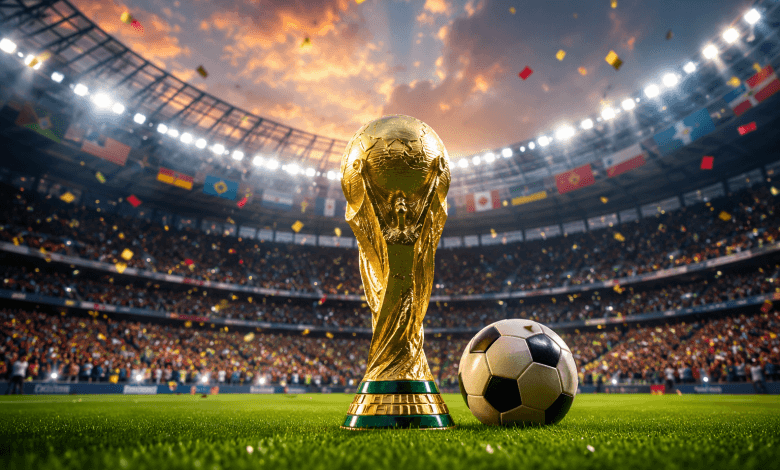
It’s match day in a small Kerala town, and the streets have gone quiet in a way that has nothing to do with the heat. Walls are painted in the colours of countries thousands of kilometres away, Brazil’s yellow, Argentina’s blue-and-white stripes. Giant cutouts of foreign footballers tower over narrow lanes. For one month every four years, a state with no World Cup team of its own turns into one of football’s most passionate fan zones on the planet.
This isn’t unique to Kerala anymore. Across India, from Goa’s coastal villages to Kolkata’s maidans to college dorms in Bengaluru – the FIFA World Cup has quietly become one of the most-watched events on television and streaming, even though India has never kicked a ball at one.
This year’s tournament, the 23rd edition, kicked off on June 11 across the United States, Canada and Mexico and it’s the biggest one in history.
Why the Whole World Stops
No other event pulls together so many people, speaking so many languages, watching the same ball roll across the same patch of grass. Part of it is simplicity, a round ball, two goals, eleven players a side. You don’t need to understand offside to feel the roar when a last-minute goal goes in.
The other part is identity. For a few weeks, an entire country becomes one family, living and dying with every match.
The World Cup Winners – A Very Exclusive Club
In 95 years and 22 tournaments, only eight nations have ever won the FIFA World Cup. Here’s the full honours list:
| Country | Titles Won | Years |
| Brazil | 5 | 1958, 1962, 1970, 1994, 2002 |
| Germany | 4 | 1954, 1974, 1990, 2014 |
| Italy | 4 | 1934, 1938, 1982, 2006 |
| Argentina | 3 | 1978, 1986, 2022 |
| France | 2 | 1998, 2018 |
| Uruguay | 2 | 1930, 1950 |
| England | 1 | 1966 |
| Spain | 1 | 2010 |
Argentina beat France 3-3 (4-2 on penalties) in the dramatic 2022 final in Qatar, Messi’s crowning moment after years of near-misses. Brazil’s first title came in 1958, when a 17-year-old Pelé scored six goals in the tournament, including two in the final, announcing himself to the world as a teenager.
Every single champion in history has come from either Europe or South America, a streak that’s held for nearly a century. With the new 48-team format opening doors for more nations, fans are wondering: could 2026 produce a ninth name on this list?
Players Bidding Farewell – The Last Dance
Every World Cup has its emotional storylines, but this one carries an unusually heavy sense of goodbye. Several legends who’ve defined football for the last decade-plus are widely expected to be playing their final World Cup:
- Lionel Messi (Argentina) already holds the record for most World Cup appearances by any player, with 26 matches across editions. At 38, this is almost certainly his curtain call on the sport’s biggest stage, a fitting farewell after finally winning it all in 2022.
- Cristiano Ronaldo (Portugal) football’s other great rival to Messi, is chasing the one trophy that has eluded him his entire career, likely for the last time.
- Luka Modrić (Croatia) the midfield maestro who dragged Croatia to a World Cup final and multiple semi-finals well into his late 30s, is expected to bow out this summer.
- Manuel Neuer (Germany) the goalkeeper who redefined the position, is nearing the end of a trophy-laden international career.
For fans, these aren’t just players leaving a tournament, they’re the closing of chapters that defined an entire generation of football.
What Makes This Edition Different
For the first time ever, three countries – the US, Canada and Mexico – are jointly hosting across 16 cities. The tournament has expanded from 32 to 48 teams, meaning 104 matches in total, 40 more than Qatar 2022.
The new format works like this: instead of the old 8 groups of 4, there are now 12 groups of four teams, with the top two from each group plus the eight best third-placed sides advancing to a brand-new round of 32 before the familiar knockout rounds begin.
Mexico becomes the first country to host three men’s World Cups, and the tournament opened with hosts Mexico facing South Africa at the historic Estadio Azteca, a stadium that has now witnessed history across three different decades.
Teams to Watch
Argentina arrive as defending champions, with France, beaten finalists last time, led by the rapid Kylian Mbappé eager for revenge. Mbappé, one of the youngest World Cup winners ever, is chasing a third straight final appearance with France. Brazil’s flair, England’s hunger for a long-awaited second title, and Spain’s technical brilliance round out the traditional contenders.
Notably, Italy four-time champions have failed to qualify again, meaning they haven’t featured at a World Cup since 2014, a stunning absence for one of football’s giants. Meanwhile, the expanded format has handed new opportunities to emerging nations from Africa and Asia, many bringing fearless, unpredictable football capable of shocking the big names.
New Technology and Format Innovations
VAR (Video Assistant Referee) a replay system helping officials review big decisions like penalties and red cards and semi-automated offside technology, which uses tracking cameras to flag offside positions within seconds, both continue in 2026. The final at MetLife Stadium in New Jersey will even feature a half-time show involving Coldplay, borrowing a page from the Super Bowl playbook.
Controversies and Concerns
Hosting across three nations and two borders raises real questions about ticket prices, visa access for travelling fans from poorer countries, and the logistics of moving teams and supporters across vast distances. Packing 104 matches into roughly five weeks has also drawn concern from player unions about fatigue and injury risk. Environmental groups have questioned the carbon footprint of a continent-spanning tournament, while debates around US immigration policy and security arrangements have simmered in the build-up.
Money, Culture, and the World Cup Effect
Prize money is up 50 percent from Qatar 2022, with every team guaranteed at least $10.5 million just for participating. Beyond the numbers, host cities typically see lasting boosts new stadiums, upgraded transport, and a generation of children inspired to pick up a football because of what they watched that summer.
India’s Growing Football Romance
Over the past decade, India’s football profile has grown significantly, the Indian Super League has brought in new fans, increased media attention, and built international partnerships. More young Indians are now choosing football as a career, thanks to expanding grassroots programmes, and Sunil Chhetri remains a towering inspirational figure for that generation.
The numbers tell a more complicated story on the field, India currently sits at 136 in the FIFA rankings, and experts widely agree the country’s biggest weakness remains a lack of grassroots infrastructure, nationwide youth academies, school leagues, and talent scouting systems that rivals like Japan, Iran and Saudi Arabia built decades ago.
But the expanded 48-team format gives Asia more World Cup qualifying spots than ever before and the consensus is clear: sustained investment in coaching, youth development and domestic football, not short-term fixes, is the only real path forward.
More Than a Game
When the final whistle blows in New Jersey, one nation will celebrate and the rest will move on until the next one. But what stays behind, long after the scoreline fades, is the memory of strangers across the world who, for one summer, watched the same ball roll across the same grass and for ninety minutes, felt like one place.