As electric cars, buses and two-wheelers steadily become a common sight on Indian roads, the country’s clean mobility revolution is now extending beyond transportation and into heavy industry. From mines to manufacturing plants, companies are increasingly replacing diesel-powered machinery with cleaner electric alternatives to cut emissions, improve energy efficiency and support India’s net-zero ambitions.
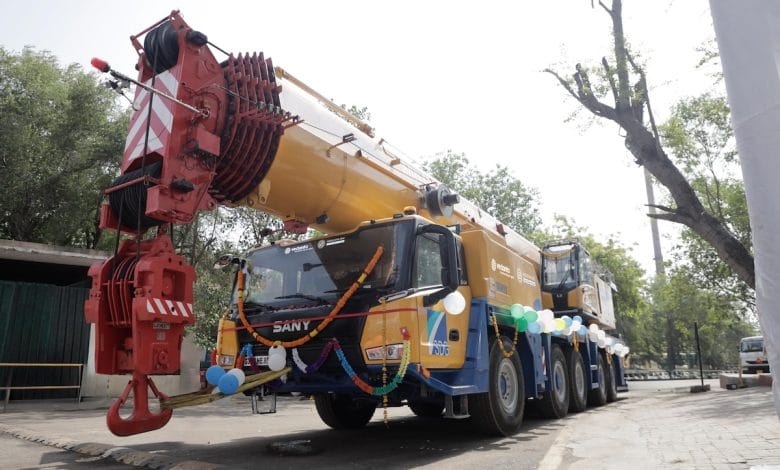
Taking a significant step in that direction, Hindustan Zinc has commissioned India’s first 250-metric-tonne hybrid electric crane at its Zinc Smelter in Debari, Rajasthan. Designed to operate on both electricity and diesel, the massive industrial crane marks a new milestone in adopting low-carbon technologies for heavy engineering and mining operations.
The deployment is expected to reduce the smelter’s dependence on fossil fuels while preventing nearly 251 tonnes of carbon dioxide equivalent (tCO₂e) emissions annually by replacing a conventional diesel-operated crane that consumes around 93,600 litres of diesel every year.
The new crane forms part of Hindustan Zinc’s larger sustainability roadmap aimed at decarbonising its mining and smelting operations. Over the past three years, the company has introduced several clean-energy initiatives, including India’s first underground battery electric vehicles (BEVs), Rajasthan’s largest fleet of electric bulkers, LNG-powered logistics vehicles, electric loaders and recently, electric buses for employee transportation.
Announcing the initiative, Arun Misra, Chief Executive Officer of Hindustan Zinc, said the company is integrating sustainability into every aspect of its operations through cleaner technologies and energy-efficient infrastructure. He said the electric crane demonstrates how even heavy industries can successfully transition toward low-carbon solutions.
The crane has been supplied by SANY India, whose Managing Director Deepak Garg described the project as a landmark in sustainable industrial innovation. He said diesel-electric hybrid technology can significantly improve operational efficiency while reducing environmental impact in sectors traditionally considered difficult to decarbonise.
Hindustan Zinc has been steadily expanding its green infrastructure since becoming the first Indian mining company to deploy underground battery-electric vehicles at its Sindesar Khurd Mine. Today, more than 250 LNG-powered trucks transport mineral concentrate between its mines and smelters, making it Rajasthan’s largest industrial LNG fleet operator.
The company aims to achieve net-zero carbon emissions by 2050 or earlier and has already increased renewable energy to nearly 18% of its power mix, with more than 530 MW of round-the-clock renewable energy capacity commissioned. It has also committed to reducing Scope 1 and Scope 2 emissions by 50% and Scope 3 emissions by 25%, compared with 2020 levels.
Among its other sustainability initiatives, Hindustan Zinc launched EcoZen, Asia’s first low-carbon zinc brand produced using renewable energy. The company also became the first Indian zinc producer to receive international Zinc Markcertification and was recently recognised as the world’s most sustainable metals and mining company for the third consecutive year in the S&P Global Corporate Sustainability Assessment 2025.