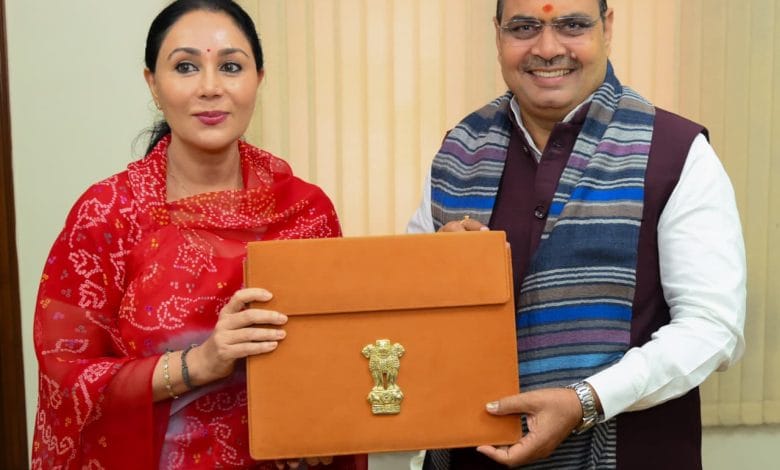
Deputy Chief Minister and Finance Minister of Rajasthan, Diya Kumari, presented the State Budget for 2026-27 in the Assembly, outlining a strong roadmap for development, employment generation and inclusive growth. The total budget size is ₹6 lakh 10 thousand 956 crore, reflecting the government’s commitment to building a developed Rajasthan under the vision of Viksit Rajasthan @2047.
The estimated revenue receipts are ₹3 lakh 25 thousand 740 crore, while revenue expenditure is ₹3 lakh 50 thousand 54 crore. The revenue deficit is projected at ₹24 thousand 313 crore. The fiscal deficit is estimated at ₹79 thousand 492 crore, which is 3.69% of the Gross State Domestic Product (GSDP). Rajasthan’s GSDP is expected to rise to ₹21 lakh 52 thousand 100 crore in 2026-27, showing steady economic growth.
The Budget is structured around 10 key development pillars aimed at transforming Rajasthan into a $4.3 trillion economy by 2047.
1. Infrastructure Expansion
A major focus of the Budget is infrastructure development. ₹1,800 crore has been allocated for construction and upgradation of state highways, bridges, flyovers and railway overbridges. More than 1,000 km of roads will be upgraded to State Highways and over 2,000 km to Main District Roads. An Intelligent Traffic Management System with 2,000 cameras will enhance road safety.
For drinking water infrastructure, more than ₹5,000 crore has been allocated. Three lakh new water connections will be provided under AMRUT 2.0. New transmission lines, 600 tubewells and 1,200 handpumps will improve water supply. A Rajasthan State Water Policy and a Bureau of Water Use Efficiency will also be introduced.
In the energy sector, new substations will be established and solar parks with 4,830 MW capacity will be developed in Bikaner and Jaisalmer.
2. Improved Civic Amenities
To enhance quality of life, 7 lakh street lights will be installed across the state. The RAJ-SETU fund will support structured urban and infrastructure financing. District-level infrastructure projects will also receive dedicated funding.
3. Industrial Development and Investment
Land aggregation for industrial areas and plug-and-play facilities worth ₹350 crore will support small and micro enterprises. Logistic hubs and Inland Container Depots will boost trade. Under the Rajasthan ODOP Policy, ₹15 crore has been allocated for micro and small industries.
4. Human Resource Development
The government aims to provide 4 lakh jobs. More than 1 lakh government jobs and over 2 lakh private sector opportunities have already been created. Recruitment for 1.43 lakh posts is in progress.
A ₹1,000 crore interest subsidy scheme will support 1 lakh youth for self-employment. Startup growth will be encouraged through programmes like VIBRANT and iStart Ambassador.
In education, more than 40 lakh students will receive free uniforms through Direct Benefit Transfer. Students of Classes 8, 10 and 12 will receive financial assistance up to ₹20,000 through e-vouchers. AI-based personalised learning labs will be set up in 1,000 schools, and 400 schools will be upgraded to CM-RISE Schools.
In healthcare, schemes like RAJ-SURAKSHA for emergency care and Raj-MAMTA for mental health have been announced. A 500-bed IPD tower in Jaipur and modern hospital facilities in major cities will strengthen medical services.
5. Social Security and Women Empowerment
Loan limits under Lakhpati Didi and women entrepreneurship schemes have been increased. 11,000 Amrit Poshan Vatikas will be constructed and 7,500 Anganwadis upgraded to Nandghars. Rural Women BPOs will create employment opportunities at district level.
6. Tourism and Culture
An Ultra Luxury Special Tourism Zone will be developed in Khuri-Jaisalmer. The Thar Cultural Circuit and conservation of 660 Shekhawati havelis will promote heritage tourism. A War Museum in Jhunjhunu has also been announced.
7. Digital Governance and Reforms
100 citizen services will soon be available on WhatsApp. 25,000 youth and women will be authorised as Mini e-Mitra service providers. The Rajasthan Cyber Crime Control Centre (R4C) will be established. New IT, Drone and Digital Infrastructure policies will support transparency and innovation.
8. Agriculture and Farmers’ Welfare
Over ₹11,300 crore will be spent on irrigation works. 50,000 solar pumps will be provided to farmers. Subsidies for farm equipment will benefit around 50,000 farmers. Centres of Excellence for onion, vegetables, kinnow and mango will strengthen horticulture.
The Cooperative Dairy Infrastructure Development Fund has been increased to ₹2,000 crore. A new milk processing plant in Alwar and 1,000 milk collection centres are planned.
9. Green Growth
Under Mission Hariyalo Rajasthan, 10 crore plants will be planted. ₹2,500 crore will be spent on water harvesting structures in 5,000 villages. Wildlife conservation, pollution monitoring and eco-parks will strengthen environmental protection.
10. Tax Reforms and Relief
The taxation policy focuses on stability, simplicity and transparency. Stamp duty and registration fees on loans have been reduced to support MSMEs. Amnesty schemes will waive interest and penalties in selected tax cases. New CNG stations and EV charging stations will promote clean energy transport.
Overall, presenting the Budget, Deputy Chief Minister and Finance Minister Diya Kumari emphasised inclusive development, youth empowerment, infrastructure growth and environmental sustainability. The Budget 2026-27 lays a strong foundation for making Rajasthan a developed and self-reliant state by 2047.