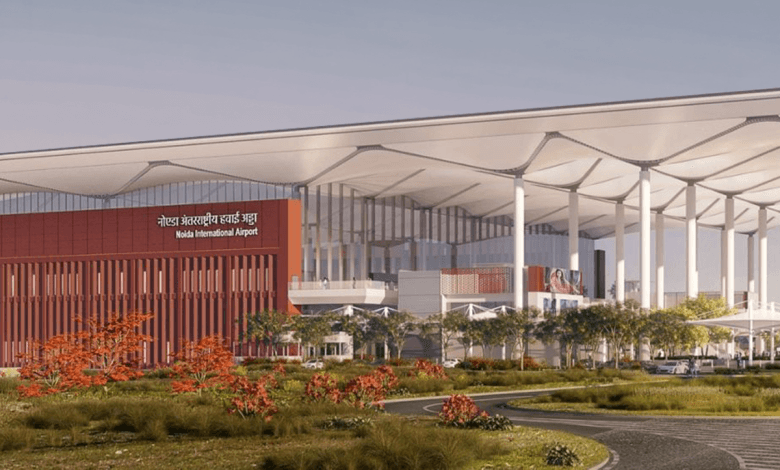
In a landmark moment for India’s aviation story, Prime Minister Narendra Modi inaugurated the first phase of the Noida International Airport at Jewar today, joined by Uttar Pradesh Chief Minister Yogi Adityanath, amid tight security arrangements and an enthusiastic public turnout. The Prime Minister undertook a walkthrough of the terminal building at around 11:30 am, followed by the formal inauguration at noon, after which he addressed a large public gathering.
The inauguration brings to fruition a project that has been years in the making. The Noida International Airport, carrying the IATA code DXN, is being developed by Yamuna International Airport Private Limited (YIAPL), a wholly owned subsidiary of Zurich Airport International AG, in collaboration with the Governments of Uttar Pradesh and India, under a 40-year concession agreement that began on October 1, 2021.
A World-Class Terminal
The passenger terminal T1, designed for both domestic and international passengers, spans an area of 1,00,000 square metres. A 3,900-metre runway, cargo terminals, air traffic control, ten aerobridges, an advanced baggage handling system, and CISF security are all operational. The terminal has been designed by a consortium of Nordic, Grimshaw, Haptic, and STUP, while Tata Projects Ltd has been appointed as the Engineering, Procurement, and Construction contractor. Phase I involves a total investment of approximately ₹11,200 crore.
Relief for Millions: Benefits to the Travelling Public
For the millions of commuters across Noida, Greater Noida, western Uttar Pradesh, Faridabad, and Ghaziabad, the new airport is nothing short of a game-changer. The airport is set to ease congestion, improve passenger experience, and provide additional capacity for growing air travel demand, offering far better access for people living in Noida, Greater Noida, and western Uttar Pradesh.
Three major Indian carriers IndiGo, Akasa Air, and Air India Express have confirmed their intent to operate from Jewar in the first phase. The Airport Economic Regulatory Authority has proposed a User Development Fee (UDF) ranging from ₹210 for domestic passengers to ₹980 for international travellers, applicable for five years from April 2026 to March 2031.
What It Means for IGI Airport
Delhi’s Indira Gandhi International Airport, long struggling under the weight of overcrowding, stands to benefit enormously. PM Modi stated that the inauguration of the Noida International Airport is expected to ease congestion at Delhi’s IGI Airport and strengthen the logistics sector with a major greenfield cargo and passenger hub. The two airports will operate alongside each other, forming a combined system aimed at reducing congestion and increasing passenger handling capacity in one of the country’s busiest travel zones.
Economic Powerhouse for Uttar Pradesh
The airport’s significance stretches well beyond aviation. Chief Minister Yogi Adityanath has projected that the airport will generate ₹1 lakh crore in revenue for the state government and help establish Uttar Pradesh as the leading economic growth engine in India. The Jewar airport is expected to play a critical role in boosting logistics, tourism, and investment flows across western Uttar Pradesh and the National Capital Region.
The airport is being built to handle 12 million passengers annually in Phase 1, growing to 60–120 million by 2050 in subsequent phases. Sustainability is a key focus, with the project using low-carbon construction materials, renewable energy partnerships, and plans for net-zero emissions operations.
Looking Ahead
With multiple airlines, phased expansion, and strong infrastructure backing, Jewar Airport is set to become a key pillar of India’s aviation growth story. As the roar of the first aircraft echoes across the Yamuna plains, one thing is clear India’s capital region has a new gateway to the skies, and the era of single-airport dependency for Delhi-NCR is finally over.