
-Surya Pratap Singh Rajawat
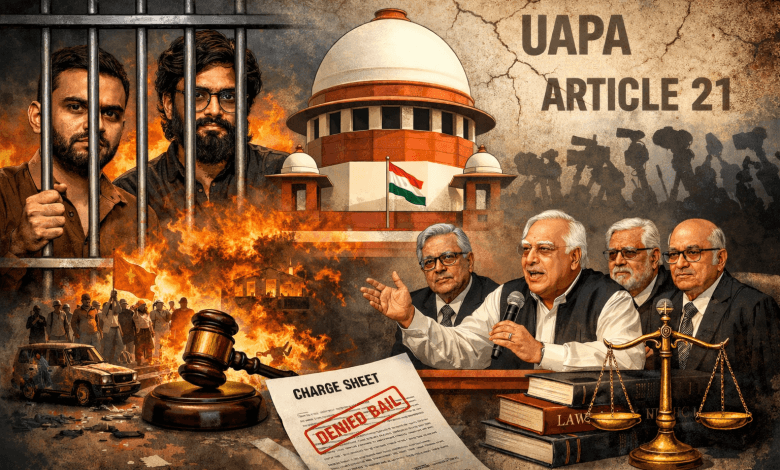
The larger conspiracy case arising out of the 2020 Delhi riots, which reportedly claimed 54 lives, has once again entered public debate due to the non-grant of bail to two accused, Umar Khalid and Sharjeel Imam, who have been charge sheeted under the Unlawful Activities (Prevention) Act (UAPA), the Indian Penal Code, and other applicable laws.
While much of the legal nuance of this case has gone unnoticed on social media, a recent panel discussion comprising senior advocate Dushyant Dave, retired Justice Madan B. Lokur, retired Justice Sudhanshu Dhulia, and moderated by senior advocate Kapil Sibal, each associated with the Supreme Court, has gone viral. The discussion raised several questions and allegations; however, the debate itself appeared to be shaped by a troubling narrative suggesting that if Kapil Sibal does not succeed in securing bail for his client, the fault necessarily lies with the Bench.
The panel went to the extent of stating that such an important matter should not have been adjudicated by the Bench comprising Justice Aravind Kumar and Justice N. V. Anjaria, and further suggested that the Chief Justice of India ought to take cognizance of this aspect in the future. Unfortunately, the discussion lacked balance and failed to engage in honest legal deliberation. Had a prosecutor or counsel representing the State been invited, the discussion could have offered a far healthier and more educative legal discourse for the public at large.
Instead, the panel discussion risked conveying to a legally uninformed audience, particularly those unfamiliar with criminal jurisprudence, that the judiciary is in a state of institutional collapse. Such a narrative borders on intimidation and carries elements of contempt of court.
A careful legal reading of the judgment, therefore, becomes essential to dispel the clouds created by this media trial of the Apex Court. It is the duty of the legal fraternity to bring to the fore the true highlights of the judgment so as to reinforce public confidence in the judiciary. The judgment itself is structured under clear headings. For the present discussion, four key aspects are examined below.
1. Prolonged Incarceration and the Constitutional Plea under Article 21
While appreciating the ratio decidendi in cases such as N. K. Najeeb, Gurvinder Singh, and Dayamani Mayamony, the Court held that Article 21 cannot be construed in isolation or in a vacuum, particularly where charges relate to national security and integrity under a special statute like the UAPA.
The judgment notes that at the stage of compliance under Section 207 of the CrPC, certain accused declined to receive copies of documents, thereby contributing to delay at the pre-charge stage. The Supreme Court refused to accept delay simpliciter as a ground for bail, emphasizing that individual liberty must be balanced against collective security. Consequently, the parameter of prolonged incarceration cannot be applied mechanically in such cases.
2. Statutory Framework of Section 43D(5) and the Scope of Judicial Inquiry at the Bail Stage
The judgment observes that Chapters IV and VI of the UAPA do not confine criminal liability merely to the execution of a terrorist act. They extend culpability to preparation, facilitation, abetment, and conspiracy, recognising that the threat sought to be addressed often materialises well before any overt act of violence.
The statute adopts a process-based conception of criminality rather than an event-based one. This legislative design makes bail adjudication under the UAPA fundamentally different from ordinary criminal cases, thereby requiring judicial restraint at the stage of consideration of bail.
3. Scope of “Terrorist Act” under Section 15 and Its Statutory Context
The judgment underlines that the consequences contemplated under Section 15 illuminate Parliament’s understanding of terrorism. Apart from death or destruction of property, the provision includes acts that disrupt supplies or services essential to the life of the community and acts threatening the economic security of the nation.
This reflects a legislative recognition that threats to sovereignty and security may arise through conduct destabilising civic life or societal functioning, even in the absence of immediate physical violence. Section 18 further criminalises conspiracy, attempt, abetment, incitement, advice, knowing facilitation, and preparatory acts. The statutory scheme thus contemplates collective and coordinated efforts involving multiple actors playing different roles towards a common unlawful objective.
4. Individualised Role and Differentiated Treatment in Bail Adjudication
The judgment explains that while conspiracy law binds multiple persons through a common design, bail adjudication operates on a different plane. It requires the Court to assess the specific role attributed to each accused, the nature of that attribution within the statutory framework, and whether continued detention serves a legitimate legal purpose at the pre-trial stage.
This approach does not dismantle the prosecution’s conspiracy case nor does it rank culpability. Rather, it ensures that pre-trial detention does not become automatic or punitive. Differentiation is not an exception to conspiracy law; it is a constitutional discipline governing the exercise of bail jurisdiction.
The judgment reiterates that Article 21 rights, though not absolute, mandate justification of continued custody with reference to the individual accused. Treating all accused identically, irrespective of their roles, risks converting pre-trial detention into a punitive mechanism. Hence, reasonable classification between principal conspirators and those with peripheral or associative involvement is constitutionally permissible.
Accordingly, the Court upheld incarceration for the alleged masterminds, two in number, while granting bail to five others with limited roles.
The judgment is self-speaking. It clearly articulates the governing principles of criminal jurisprudence in the context of a special statute like the UAPA, harmonising constitutional guarantees under Article 21 with national security concerns, conspiracy law, and bail adjudication standards in cases of prolonged incarceration.
In sum, the legal position emerging from the judgment may be succinctly stated as: jail for the masterminds, bail for the minions.