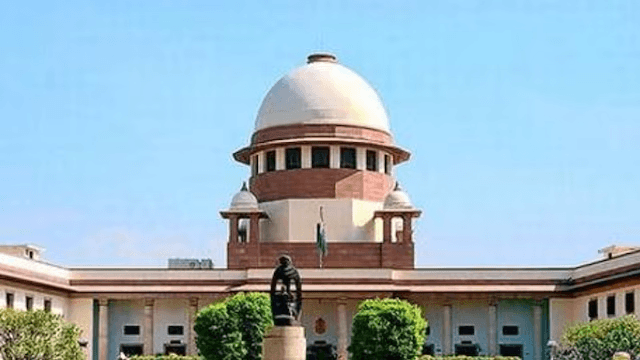
The collegium system through which existing judges appoint judges of the Supreme Court and high courts in India has always been the bugbear of the political leadership in India.
Appointment of judges in India’s constitutional courts is probably the only appointment where the two branches of the state, legislature and executive, have no say. The system has been in place to ensure judicial independence even though the Constitution has no explicit mention about the collegium system. For the reason that the legislature and the executive have no say in this system, the two have often tried to question it, criticizing the collegium system for its vagueness and room for favouritism. In 1998, using his Constitutional powers, the then President K.R. Narayanan raised a question of law regarding the collegium system but the Supreme Court’s opinion – that the system was well within the basic structure of the Constitution – settled the debate. Then in 2014, the Modi government introduced the National Judicial Appointments Commission (NJAC) Bill for establishment of an autonomous, independent body to recommend names for judicial appointments.
The Bill was ratified by 16 State Assemblies and assented to by the President in December 2014. According to the NJAC Act, 2014, the commission had to have the Chief Justice of India as its ex officio chairperson, two other senior judges of the SC as the ex officio members, the Union minister in charge of Law and Justice as ex officio member, and two eminent persons nominated by a committee consisting of the Prime Minister, the Chief Justice of India and the Leader of Opposition in Lok Sabha. This way the legislature and the executive would also have a say in the appointment of judges but the Supreme Court struct down the NJAC Act in October 2015. The top court called the new law as unconstitutional for violating the basic structure of the independence of judiciary, and the effort to make appointment of judges more accountable and transparent ended up being stillborn. Primacy of the collegium system prevailed. The collegium system has been in place since 1993 – prior to that the President appointed judges in consultation with the Chief Justice and two other senior-most judges of the Supreme Court. The Supreme Court collegium consists of Chief Justice and four other senior-most judges of the Supreme Court. The High Court collegium comprises Chief Justice and two other senior-most judges of that court.
Now, Vice-President Jagdeep Dhankhar has revived the issue of Parliament’s intervention in judicial appointments, during a meeting he held this week in the wake of recovery of currency notes at the official residence of Delhi High Court judge, Justice Yashwant Varma on March 14. Voicing the legislature’s long desire for an alternative to the current collegium system, Dhankhar said: “Now, it is befitting the occasion to reiterate that it [NJAC] was a visionary step, and imagine if it had taken place, things would have been different.”
The Chief Justice of India has constituted an in-house inquiry to probe the allegations of misconduct against Justice Varma following recovery of huge piles of cash at his residence during a fire-control operation. The in-house inquiry in Justice Varma’s case is being done by a panel of three judges: Chief Justices of Punjab and Haryana High Court, the Chief Justice of Himachal Pradesh High Court and a judge of the Karnataka High Court. The panel has visited Justice Varma’s official residence at Tughlak Crescent residence and is recording statements of people who are associated with the recovery of notes. Just as appointment of judges is done by judges themselves, complaints of misbehaviour against judges are also probed by judges. According to the in-house procedure of inquiry, when a complaint is received against a judge of a high court, the CJI forms a three-member committee consisting of two chief justices from other high courts and one high court judge. If the complaint is against a Supreme Court judge, the in-house inquiry committee has three SC judges. Details of the in-house inquiries are kept confidential by the Supreme Court. Dhankhar’s initiative to rekindle the debate around the NJAC, or any other system, which is better than the current collegium system, may still hit the Supreme Court roadblock but no one can deny the fact that India needs a better system of choosing its judges and inquiring into allegations of misconduct by them. There are many models that India can adopt. Like the judicial services commission of South Africa, India can have a broad-based commission headed by the CJI with representatives from various stakeholders including members of the legislature, lawyer associations and academia, to recommend names for judicial appointments. And, for inquiries, the country can have an autonomous statutory office like the Judicial Conduct Investigations Office of the United Kingdom to investigates allegations of judicial misconduct. In order to instill confidence in the process of judicial appointments and inquiries against judges, it is imperative that all opaqueness of the collegium process and that of the inquiry, some changes need to be done. Whether they are done by the judiciary, or by the legislature, is immaterial – change is what matters.