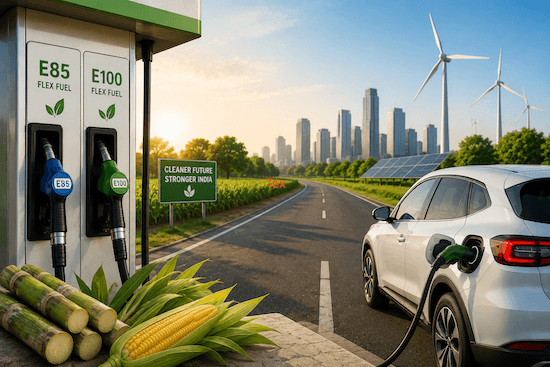
India is accelerating its transition towards cleaner mobility, with a dual push for higher ethanol blending and electric vehicles (EVs). The government’s recent proposal to enable E85 and E100 fuels under vehicle regulations signals the next step beyond E20 petrol, which has already been rolled out across the country.
The goals are clear: reduce dependence on imported crude oil, cut emissions, and support domestic agriculture. But as India moves from policy intent to implementation, an important question arises, is the transition aligned with the realities of consumers and infrastructure?
From E20 to E100: A Significant Shift
India’s achievement of E20 fuel availability marks real progress. However, moving to E100 is not simply an incremental step, it requires a different vehicle ecosystem.
Unlike E20, E85 and E100 fuels require flex-fuel vehicles (FFVs) designed to handle higher ethanol content. Most vehicles currently on Indian roads are not built for such fuels, especially older models.
What It Means for Citizens
For everyday users, this transition raises practical concerns.
Vehicles not designed for high ethanol blends may experience higher wear and tear over time, particularly in fuel systems. Ethanol also has lower energy density than petrol, which can result in reduced fuel efficiency, depending on the engine.
For many households, vehicles are long-term investments. Any shift that requires modifications or early replacement could create unexpected financial pressure, especially without clear transition support.
Policy Gap: Production vs Usage
A key concern is the gap between fuel policy and vehicle manufacturing.
While cleaner fuels are being promoted, petrol and diesel vehicles continue to be widely produced. Without a clear roadmap for gradually shifting manufacturing towards flex-fuel or cleaner technologies, the responsibility of adjustment may fall disproportionately on consumers.
In recent observations, the Supreme Court has suggested that the government explore restrictions on high-end petrol and diesel vehicles as a possible starting point. The idea is to encourage transition without immediately affecting middle-income users.
Beyond Vehicles: Resource and Infrastructure Challenges
Scaling up ethanol use also brings structural challenges.
India’s ethanol production relies significantly on sugarcane, a water-intensive crop. Expanding production must be balanced against water availability and agricultural sustainability.
There is also the question of infrastructure. Widespread use of E100 would require adapted fuel storage, distribution systems, and retail infrastructure, which are still evolving.
EV Push: Progress with Open Questions
Electric vehicles are the second pillar of India’s clean mobility strategy. While EV adoption is growing, challenges remain charging infrastructure gaps, higher upfront costs, and range concerns continue to affect consumer confidence.
The Supreme Court has recently asked the government to present a clearer roadmap for EV implementation, including infrastructure readiness. This reflects a broader need for clarity in execution.
Environmental concerns are also being raised. Advocate Prashant Bhushan has highlighted the need for a comprehensive plan for EV battery waste management, an area where policy is still evolving.
From Battery Waste to a Wider E-Waste Issue
The discussion around EVs also connects to a larger issue electronic waste management.
India is already a major generator of e-waste, including discarded electronics and appliances. The addition of EV batteries, which are larger and more complex, will increase the need for formal recycling systems.
If not properly managed, battery waste can pose environmental risks, including soil and water contamination. This makes it essential to develop robust recycling and disposal frameworks alongside EV adoption.
Balancing the Transition
India’s push towards cleaner energy is both necessary and timely. However, transitions of this scale require careful sequencing.
Ethanol and EVs both offer benefits, but also come with trade-offs:
- Ethanol supports energy independence but raises concerns about vehicle compatibility and resource use
- EVs reduce emissions but depend on infrastructure and waste management systems
The Way Forward
For the transition to succeed, it must be phased with realistic timelines, allowing both industry and consumers adequate time to adapt. It also needs to be aligned across policy, manufacturing, and infrastructure, ensuring that fuel availability, vehicle readiness, and support systems evolve together rather than in isolation. Equally important is making the transition inclusive, with a clear focus on consumer affordability so that the financial burden does not fall disproportionately on ordinary citizens. Finally, the approach must remain sustainable, addressing long-term environmental risks such as resource use and waste management, rather than shifting the problem from one sector to another.
Ultimately, the success of India’s green mobility shift will depend not just on ambition, but on execution that works for its people.
Because a transition is truly successful only when citizens can move forward with it, not struggle to keep up with it.