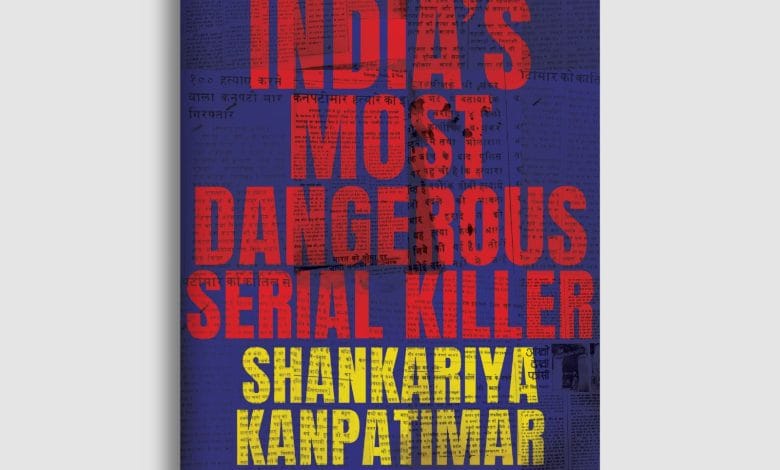
True crime usually offers a deal. Give the reader a killer, a method, a chase, an ending. Close the book, sleep at night. India’s Most Dangerous Serial Killer Shankariya Kanpatimar, the new work by journalist and Indian Institute of Mass Communication professor Rakesh Goswami, refuses that deal. It hands you the killer in the first few pages and then quietly walks you somewhere else. To the files. To the footprints. To the men who saw it first and were told to stand down.
Shankariya Kanpatimar is often introduced as India’s first serial killer. Between 1977 and 1978, in roughly eighteen months, he is held responsible for nearly seventy murders across Rajasthan, Punjab, and Haryana. His method was numbingly consistent. He entered homes at night, often without clothes. He used whatever tool the house provided, a hammer, a blunt object. He struck victims on the temples, the kanpati, the detail that would later name him. Then he ate. Smoked bidis. Sometimes bathed. Walked away with cash that occasionally amounted to two rupees.
The contradiction does the damage. Brutality this absolute, gain this small. No ritual. No symbolism. No psychological grand narrative of the kind Mindhunter readers expect. Goswami does not pretend to enter that mind. He stays outside, deliberately, and that restraint is the book’s spine.
Because the real subject is not Shankariya. It is the system that took too long.
Drawing on FIRs, police files, contemporary reports, and interviews, Goswami reconstructs how three states failed to connect murders that shared a method, a window, and a signature. Cases sat in silos. Information moved by paper, slowly, between jurisdictions that did not coordinate. There was no DNA, no central database, no inter-state digital wire. The book grants the era its limits. What it does not grant is the hierarchy that made those limits worse.
Names matter here, and Goswami uses them. Sub Inspector Jagmalram Bissu spotted the pattern early. He pushed for the murders to be treated as connected, for one investigation rather than many. He was sidelined. Not refuted on evidence, simply moved out. Above him was Superintendent of Police Rathore, whose authority, the book suggests, became more important than the truth Bissu was carrying.
Then there are the khojis the local trackers most readers have never heard of. Jhangi Ram, working at Sri Karanpur, read footprints that pointed toward Shankariya. No lab. No instrument. Years of reading sand and gait. In another system, the find triggers urgency. Here it became another file. CID Inspector Om Prakash Puri eventually pulled the threads together and broke the case. Recognition, predictably, drifted upward, toward those better positioned in the chain.
This is the pattern Goswami refuses to soften. Junior officers and constables saw what was happening on the ground. Their insight had to climb a ladder, and the ladder filtered. Sometimes hierarchy. Sometimes ego. Sometimes, the book hints, the quieter geometry of caste and network. Effort and acknowledgement travelled on different roads.
The prose matches the argument. No drama, no music. The tone is almost clinical, and that restraint is what makes the horror land. Goswami does not tell readers what to feel about Shankariya, or about Rathore, or about the system. He places the documents on the table and trusts the reader to look. Some will find this frustrating, the book offers no neat verdict, no closure on whether confessions were coerced, no full psychological portrait. That refusal is the point. The case itself never closed cleanly. The book honours the gap.
Politics threads through, neither as villain nor saviour. Opposition voices in legislative assemblies did raise the matter; pressure was applied; the government had to respond. But pressure on a strained system can also distort it, speed beating accuracy, closure beating clarity.
Shankariya was caught, tried, executed. On paper, the system worked. The book asks the harder question. If justice includes prevention, and recognition of the people who actually do the work, then the story finishes incomplete. How many died between the moment Bissu first spoke and the moment someone above him finally listened?
That question does not stay in 1978. Delayed coordination, hierarchy that slows urgency, credit that flows to position rather than contribution, readers will recognise the shape of it in newsrooms, hospitals, corporates, and ministries today.
Goswami has not written a thriller. He has written an indictment in a quiet voice. The book is dense in places. The emotional interiors of its investigators stay closed. Fast-paced readers will resist it.
Sit with it anyway. The crimes will not be what stays. The gaps will.