Vinay Khandelwal
In today’s health-conscious world, many of us carefully track calories, nutrients, and portion sizes. Every meal is evaluated based on one question: Will this help me lose weight?
I, too, lived with this mindset, until I paused and asked a deeper question – What about the weight my mind and soul are carrying?
While I was busy measuring food intake, I had overlooked something equally important, what I was “consuming” emotionally and mentally. Were my thoughts healthy? Were my interactions nourishing or draining? Was my inner self strong or struggling?
This realisation led me to a simple but powerful insight: health is not just physical, it is holistic.
Just as food affects the body, people, experiences, and environments affect the mind and soul. Some uplift us, while others leave us feeling heavy, anxious, or demotivated. The challenge, however, is that we cannot completely control who enters our lives or what situations we face.
What we can control is how much we allow these influences to affect us.
Think of it this way, every interaction has a “nutritional value.” After meeting someone or going through an experience, ask yourself:
Do I feel calm or agitated? Energised or drained? Positive or hopeless?
These emotional responses are indicators. They tell us whether something is nourishing or harmful to our inner well-being.
Just as we choose what to eat based on health goals, we must also learn to choose what to allow into our mental and emotional space. This doesn’t always mean cutting people off, but it does mean setting boundaries deciding what to accept, what to limit, and what to let go.
In physical diets, we often sacrifice immediate cravings for long-term health. Similarly, for mental and emotional well-being, we may need to distance ourselves from negativity, even if it feels uncomfortable in the moment.
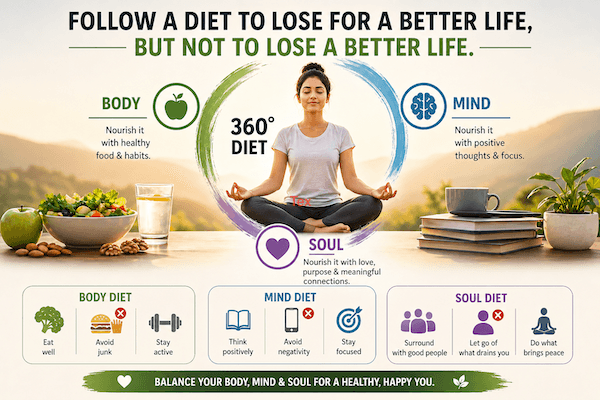
The solution is simple: create a “360-degree diet chart” not just for your body, but also for your mind and soul.
- For the body: what to eat and avoid
- For the mind: what to think, consume, and focus on
- For the soul: who to connect with and what truly brings peace
This doesn’t need to be complicated. Write it down in a diary or your phone or somewhere visible. Over time, it becomes a guide, helping you respond to life more consciously rather than react impulsively.
Life will always bring situations beyond our control. But with this balanced approach, we can control our reactions, maintain inner stability, and live with greater clarity.
In the end, the message is simple but powerful:
Follow a diet to lose for a better life but not to lose a better life.
Before making choices, pause and ask yourself:
- Is it worth my time?
- Does it truly make me happy?
- Will it add value to my life?
Your inner voice already knows the answer. The key is to listen and act.
Because true health is not just about looking good.
It is about feeling balanced, centred, and at peace.